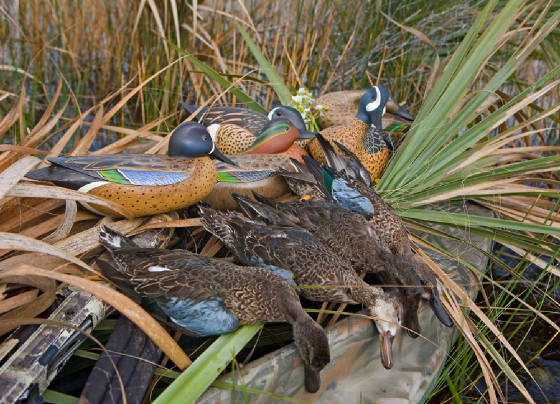
It has always been my contention that decoys,
especially old, handmade ones, must have lived very interesting lives . While thinking about this, 17
years ago now, I wrote down this story that tells of just such a decoy and the life it might have led .
Jode
An edited version of this story ran in the May/June 2009 issue of "Hunting and Fishing Collectibles
Magazine"
A quiet backwater
eddy swirled around the bend of the coffee colored stream. Leaves, branches and other debris drifted and settled in the lazy
current. Reflections of towering trees danced in the afternoon sun. Then the silence was shattered . The roar and splash were
deafening. Thirty-seven cedars all collapsing to the ground in unison. The farmer looked on with glee as he saw the first-fruits
of what he hoped would be a very profitable venture for he and his family. The land had been bought at a reasonable sum, as
the sandy, acidic soil was not very good for most crops. He had heard though , that cranberries would grow well here. There
was a market for them too, as sailors were now using them in their rations to ward off scurvy and other seagoing ailments.
He was clearing an ancient cedar bog a few miles inland of the New Jersey coast. The trees, all large and straight,had to
be clear cut as they grew so tall and closely that cutting a single tree would merely leave it supported by its brethren.
In the last fading light of dusk the lumberjack , wet ,muddy, and tired gave the farmer the agreed upon price for his trees
and set about to saw and market the wood.
Most of the cedar was beautiful. Typical of lumber from such regal old
trees . A shipwright from a nearby coastal village heard of this and bought a large amount from the lumberjack. He used it
to build sloops, schooners, coasters, and occasionally a little pumpkinseed shaped gunning skiff that was becoming popular
in the area. It was just such a skiff that a gentleman was coming to pick up later that day. The man, Ben Reed , who was to
be the skiffs new owner, was a stout and somewhat grizzled bayman. He made his living off the waters surrounding his families
home. It was the same water his Father and Grandfather had lived off as well. He raked clams, hauled nets for fish , and led
"sports" out for hunting excursions in the fall and winter. It was for just such hunting trips that the skiff was to be used
for. The "sports" you see, disliked getting so muddy and wet sitting on the old bushel baskets Ben had out in his favorite
duck spots. Ben figured with the new skiff he would have as many takers as needed to keep him busy once gunning time rolled
around.
Ben and the shipwright
exchanged small talk as they drug the skiff out of the shop and down the bank to the creek. " Nice wood she's got in her "
said Ben, " Yessir, she a good one alright" the builder quipped back. Ben wondered aloud if there were any nice scraps lying
about that he may help dispose of. " Sure " The old builder replied " Gotssa few punky pieces up front o' the shop there.
Not good fer much but yer welcome to a few." Ben knew the dank wood wouldn't be very good, but he saw a few of the boards
had a foot or so at the ends that was pretty solid. "Could probably get a teal outta somma them" he thought. So he loaded
an armful of the sweet smelling wood into the little boat . He rowed into the salt air, bound for home and family.
It was later that summer
before Ben got a chance to look the wood over closer. The birds would be here soon and he needed a few new blocks to add to
his rig. Disappointedly he looked at the stock. It had dried out but still most of it was unusable. There was one section,
of one board though, that only had a bit of rot in the middle of one face. " I can work around most o that " Ben thought,
"could make a nice hollow 'tween the shoulders there too. " He decided that he would make a hen teal out of it and get a new
load to make the bulk of his rig. When Ben finally began to work the wood , it curled away effortlessly as his drawknife
shaped the bird cleanly. He cleared out the rotten wood on top and a soft graceful hollow appeared from the ducks back. The
head was equally as nice. Working with his rasp and gouge a whimsical smiling face soon appeared from the rough wood. For
eyes he used brass tacks salvaged from old sea chests. As the light from his old oil lamp faded, his youngest daughter, Eliza
, now three, crawled over and peered up at the bird on the kitchen table. " Ducky, dadda, Ducky" she softly babbled over and
over. " It's not the first bird she's ever seen ," Ben thought. " I guess for some reason she just really likes it," he said
to his wife . Late into the night Ben worked as he painted the last details onto the bird. In the morning, when the paint
was dry, Ben scraped it away from "Ducky's" eyes. She stared back through deep brown sea aged brass. It was as if the little
bird had just magically been born.
Ducky, as Ben fondly thought of her, spent the rest of
that summer in an old feed sack. Newly finished blocks piled atop her as they were completed. Slowly however , the air began
to change, and the breeze stiffen out of the northwest. It was a telltale sign. Soon the birds began arriving. In scattered
groups at first . Then in flocks numbering in the thousands. Gunning season had finally come. Ducky's first hunt was a
good one. Ben set her along with the 40 or so other birds in his rig. The long sloping point he and his hunters were on jutted
into the bay and was heavily trafficked by all kinds of fowl. As they sat in the predawn darkness wings whistled and sliced
the air. First light saw birds pitching to the blocks left and right with nary a quack from Ben. The " Sports" he was guiding
fired again and again . Occasionally a bird would drop. Sandy , Ben's, faithful retriever would bring them to hand perfectly.
On more than one occasion Ben had to reprimand his charges. Nothing made him madder than shooting over the dog trying to hit
a swimming bird. " How desperate they are " he thought. "More birds will come, just be patient," he admonished them. As the
sun rose higher more ducks were laid low. Blacks, Mallards, Green teal, Baldpates, and even a lone Brant fell to the guns.
Through it all Ducky did her duty . Coyly luring her own to their demise.
Soon word spread of Ben's prowess and his great rig. All that
season and for many more Ben was quite busy. Plentiful birds and lots of good marsh made for hot gunning. As Ben acquired
stature and respect, Ducky acquired much lead and wear. On more than one occasion a wealthy businessman or lawyer would try
to buy her. The answer though was always the same. A polite but firm " No". Sadly as the years passed, the great number
of duck began to diminish. The well- to -do gunners started to head farther south, to the still teeming Chesapeake area and
Tidewater of Virginia. The eelgrass and wild celery to began to fade, and with it so did Ben. His children had grown and moved
inland. Yet occasionally, alone, he would still take out his old rig. He loved to watch the ducks cartwheel and spin as they
would pitch in around Ducky at full speed. Rarely did he even shoot. It wasn't that he was soft , he had just seen enough
dead birds in his time. On the wing they thrilled him like when he was young. Sometimes he would still bring one down, his
accuracy uncanny for a man of his age. It was mostly for Tar though, Sandy's Great grandpup, for Ben knew how much that dog
loved his job. One evening, after just such a day, Ben closed his eyes and fell asleep for the last.
Years later in his inland backyard, Ben's grandson, Lem now 14, was rummaging through the cluttered shed. When he picked up
an old dusty gunny sack, out fell some battered wood birds. Among them was Ducky. She was worn and faded ,yet still smiled
whimsically at Lem. A boy who loved the woods and water, Lem asked his Mom if he could use Grandpa's old birds. " Sure", she
said , "that's what they were meant for, but be careful." The next day after school Lem hurried home and finished
his chores. It was cloudy out and a storm would soon be here. Lem though, wanted desperately to try out his new find. A man
like his grandfather, he knew today would be good. Lem had no boat, nor even a dog, yet with his trusty model 12 Winchester
he did the job. He went to the only place he could , a creek not far from his home. Using a long branch he set his birds in
the current, with Ducky at the lead. He waited and waited yet no ducks would show. The wind picked
up and gusted through the trees as the storm drew closer. Ducky bobbed and swirled as she had for so many years before. Then
, just before sunset, a new arrival . A lone drake Mallard dropped through the trees with the rain. Lem raised his gun and
a single report folded the red -legged bird cleanly. With a strange accuracy the Drake landed fully on the lead block. Ducky's
worn old hemp line could not take the shock and parted neatly. Intently focused on retrieving the dead Mallard, Lem never
saw Ducky float gingerly away.
The rain pounded that night and into the day. Ducky careened recklessly downstream,
debris filling the hollow in her back. For days she was aimlessly adrift. Later, as the high water slowly abated, Ducky was
brought to rest in an old familiar place. It was a quiet backwater eddy of a coffee colored stream. An abandoned cranberry
bog was nearby, which was slowly being reclaimed by straight tall cedars. As the skies cleared , the breeze blew softly. Ripe
seeds from the nearby cedars floated in the wind. Some landed in the gracefully carved hollow on Ducky's back. They had found
a good place to rest, and so too had Ducky.
Content Copyright of Hillman Decoys 2004-2024 All rights reserved.